
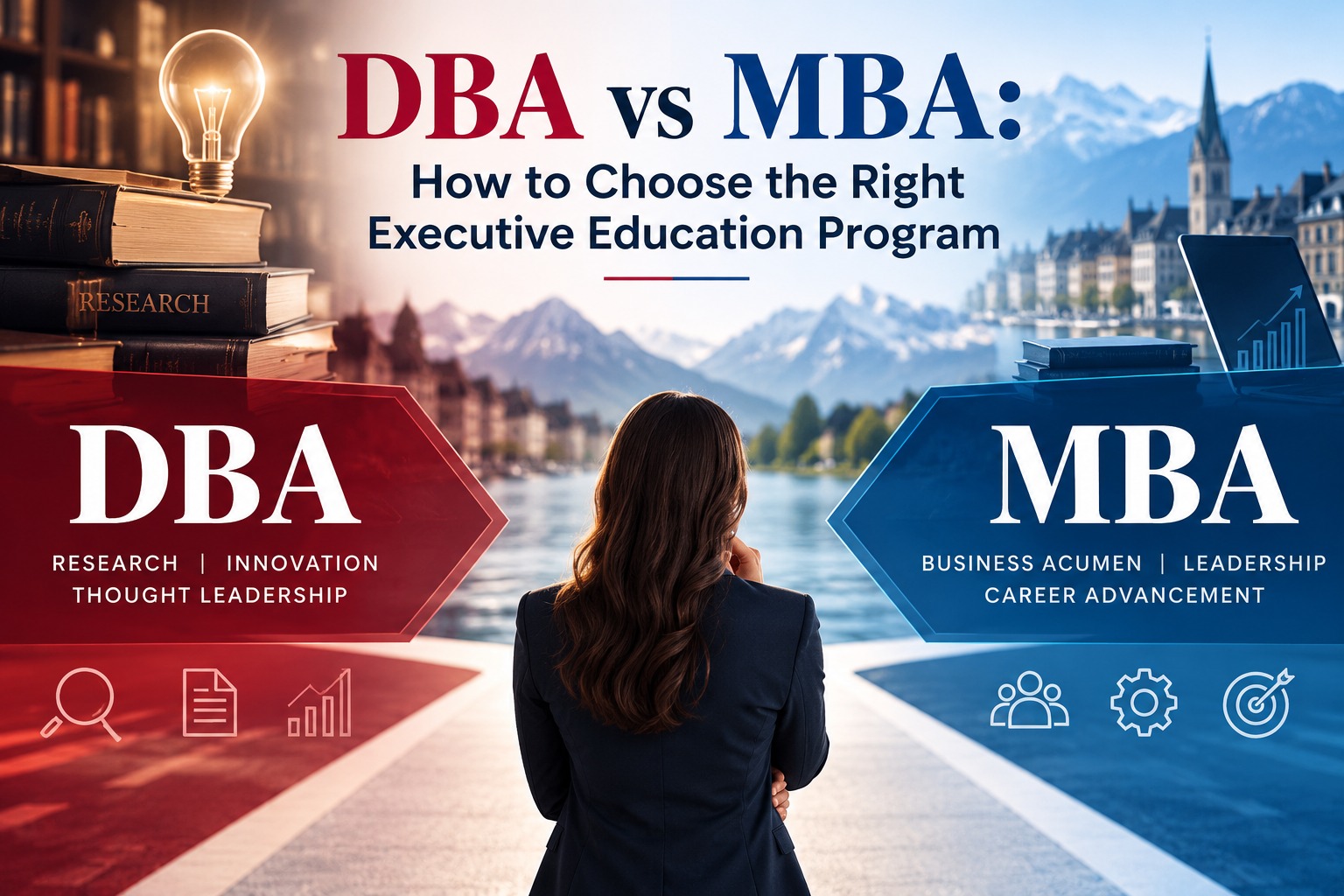
Choosing the right advanced business education program can be a significant decision for professionals who want to strengthen their expertise, leadership capabilities, and long-term career prospects. Among the most popular options for experienced professionals are the Master of Business Administration and Doctor of Business Administration .
The DBA vs MBA discussion is particularly important for professionals who are looking beyond traditional qualifications and want an education that aligns with their career stage and professional goals. While both programs focus on business, management, and leadership, they serve different purposes and are designed for different stages of professional development.
Understanding the difference between DBA and MBA can help working professionals, executives, managers, entrepreneurs, and senior leaders make a more informed decision.
What Is an MBA?
A Master of Business Administration (MBA) is a postgraduate business qualification designed to develop a broad understanding of management and business functions. MBA programs typically cover areas such as finance, marketing, human resources, operations, strategy, business analytics, and leadership.
An MBA can be suitable for professionals who want to develop managerial capabilities, move into leadership positions, change their career direction, or gain a stronger understanding of how different areas of an organization work together.
For professionals who are still developing their management experience, an MBA can provide a structured foundation in business administration and help them understand how organizations make decisions and manage resources.
Who Should Consider an MBA?
An MBA may be appropriate for:
- Professionals seeking management positions
- Managers looking to strengthen business knowledge
- Professionals planning a career transition
- Entrepreneurs who want broader management knowledge
- Employees aiming for greater leadership responsibility
- Professionals who want to specialize in areas such as marketing, finance, HR, operations, or business analytics
The MBA is therefore often considered a practical management-focused qualification that can support career development across a variety of industries.
What Is a DBA?
A Doctor of Business Administration (DBA) is an advanced doctoral-level business qualification that focuses heavily on applied research, strategic thinking, and solving complex organizational problems.
Unlike an MBA, which generally emphasizes learning established business concepts and management practices, a DBA encourages experienced professionals to investigate real-world business challenges through structured research.
A DBA can be particularly relevant to senior managers, executives, consultants, entrepreneurs, and business leaders who want to combine professional experience with research-based knowledge.
The program may involve areas such as organizational strategy, leadership, innovation, business transformation, decision-making, and applied research.
Who Should Consider a DBA?
A DBA may be suitable for:
- Senior managers and executives
- Experienced business professionals
- Entrepreneurs and business owners
- Management consultants
- Professionals interested in applied business research
- Leaders who want to solve complex organizational challenges
- Professionals interested in contributing research-based insights to their industry
The DBA is generally more research-oriented than an MBA and is particularly relevant for professionals who already have substantial business experience.
DBA vs MBA for Working Professionals
One of the most important considerations in the DBA vs MBA for working professionals debate is professional experience.
An MBA can be valuable for professionals who want to build or strengthen their management foundation. It can help learners understand different business functions and develop skills required for managing teams, projects, and organizational activities.
A DBA, on the other hand, may be more suitable for professionals who already have considerable experience and want to explore business problems at a deeper level.
For example, an experienced manager may have encountered challenges related to employee performance, organizational transformation, digitalization, supply chain management, or strategic decision-making. A DBA can provide an opportunity to examine such challenges through systematic research and develop evidence-based insights.
Therefore, the choice should not simply be based on which qualification is considered “higher.” Instead, professionals should consider their current career stage, experience, objectives, and preferred learning approach.
DBA vs MBA for Executives
The DBA vs MBA for executives comparison becomes particularly relevant when professionals reach senior management or leadership positions.
Executives often have extensive practical experience and may already understand the fundamentals of business management. At this stage, they may want to develop advanced strategic thinking and investigate complex organizational issues.
An MBA can still be useful for executives who want to strengthen their overall management knowledge or develop expertise in a specific business discipline. It can also support professionals transitioning into management or leadership roles.
A DBA may be more appropriate for executives who want to go beyond conventional management education and engage with applied research. The research process can encourage them to critically examine business practices, evaluate existing approaches, and develop solutions to organizational challenges.
For example, a senior executive working in digital transformation might use doctoral research to investigate how organizations can successfully implement new technologies while managing organizational change.
Understanding the Difference Between DBA and MBA
Understanding the difference between DBA and MBA requires looking at several factors, including purpose, learning approach, professional experience, and research requirements.
| Factor | MBA | DBA |
|---|---|---|
| Qualification level | Master’s-level business qualification | Doctoral-level business qualification |
| Primary focus | Business management and administration | Applied business research and advanced leadership |
| Typical audience | Managers and professionals | Experienced professionals and executives |
| Learning approach | Management concepts and practical applications | Research, analysis, and application to business problems |
| Career focus | Management and leadership development | Senior leadership, consulting, research, and specialized expertise |
| Research intensity | Usually moderate | Generally high |
| Dissertation/Research | May include a project or dissertation | Significant doctoral research/dissertation |
| Professional experience | Varies by program | Often more suitable for experienced professionals |
The distinction is important because the two programs are not necessarily direct substitutes. They can serve different professional purposes.
MBA vs DBA Career Opportunities
When considering MBA vs DBA career opportunities, professionals should think about their desired role rather than simply focusing on the qualification itself.
An MBA can support career opportunities in areas such as:
- Business management
- Marketing management
- Financial management
- Human resources
- Operations
- Business analytics
- Project management
- Sales and business development
- General management
A DBA can support advanced professional pathways such as:
- Senior executive leadership
- Strategic management
- Business consulting
- Organizational transformation
- Business research
- Executive-level management
- Academic or teaching-related opportunities, depending on institutional requirements
- Specialized advisory roles
However, career outcomes depend on several factors, including professional experience, skills, industry, specialization, networking, and the institution offering the qualification. Neither degree automatically guarantees a particular position or salary.
Should You Choose an MBA or DBA?
The answer depends largely on where you are in your professional journey.
Choose an MBA If:
An MBA may be the better choice if you:
- Want to build a strong foundation in business management
- Are moving into a managerial role
- Want to switch career functions or industries
- Want broader knowledge of business operations
- Are interested in a specific management specialization
- Want to strengthen your leadership and managerial skills
For example, a marketing professional who wants to move into a broader business management position may find an MBA useful because it exposes them to finance, strategy, operations, leadership, and other areas.
Consider a DBA If:
A DBA may be worth considering if you:
- Already have substantial professional experience
- Work in a senior management or executive position
- Want to investigate complex business problems
- Enjoy research and analytical work
- Want to develop evidence-based solutions
- Are interested in strategic leadership
- Want to contribute knowledge to your professional field
For example, a senior operations manager could pursue DBA research into supply chain resilience, while an entrepreneur might investigate strategies for sustainable business growth.
How to Choose the Right Executive Education Program
Before selecting an executive education program, consider the following factors.
1. Assess Your Career Stage
Your current professional experience should be one of the first factors you consider. If you are developing your management foundation, an MBA may be appropriate. If you are already an experienced professional seeking advanced research-oriented education, a DBA may align more closely with your needs.
2. Define Your Career Objective
Ask yourself what you want to achieve after completing the program.
Do you want to become a manager? Change your specialization? Move into senior leadership? Solve complex business problems? Develop research expertise?
Clearly identifying your objective can make the decision easier.
3. Consider Your Learning Preference
MBA programs generally focus on management concepts, business cases, practical applications, and decision-making.
DBA programs involve greater emphasis on research, critical analysis, academic literature, methodology, and developing research-based solutions.
If you enjoy investigating questions and analyzing business problems deeply, the research component of a DBA may appeal to you.
4. Evaluate the Curriculum
Do not choose a program based only on its title. Review the curriculum carefully.
Look at subjects, specialization options, research requirements, faculty expertise, learning format, assessments, and dissertation expectations.
The curriculum should match your professional interests and long-term goals.
5. Consider Flexibility
Working professionals often need education that fits around their existing responsibilities. Before enrolling, evaluate the program’s schedule, delivery format, learning resources, assessment structure, and support available to working professionals.
A flexible executive education program can make it easier to balance professional responsibilities with academic commitments.
6. Research the Institution
The institution offering the program is another important consideration. Review its academic structure, faculty, program information, policies, student support, and recognition or affiliations as applicable.
Professionals should also carefully review what the qualification represents and whether it meets their personal and professional requirements.
Can an MBA and DBA Complement Each Other?
Yes. For some professionals, an MBA and DBA can represent different stages of professional and academic development.
An MBA can provide a broad understanding of business management, while a DBA can allow an experienced professional to explore a specific organizational or industry problem through advanced applied research.
For example, an individual may first develop management knowledge through an MBA and later, after gaining substantial professional experience, pursue doctoral-level business education to investigate a specialized area of strategic importance.
However, pursuing both is not necessary for everyone. The right pathway depends on your career goals, previous qualifications, professional experience, and interest in research.
Final Thoughts
The DBA vs MBA decision should be based on your career stage, professional experience, learning objectives, and long-term ambitions.
An MBA is generally focused on developing management knowledge and preparing professionals for broader managerial and leadership responsibilities. A DBA takes a more advanced, research-oriented approach and can be particularly relevant for experienced professionals and executives who want to investigate complex business challenges.
Ultimately, there is no universal answer to whether an MBA or DBA is better. The right executive education program is the one that matches your current capabilities and helps you move toward your desired professional future.
Before making a decision, compare the curriculum, eligibility requirements, research expectations, flexibility, institutional information, and career relevance of each program. A well-informed choice can help ensure that your investment in executive education supports meaningful professional and intellectual growth.